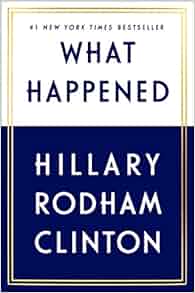
Dork score: 8/10
Every day since the 2016 presidential election I'm disgusted by what many Americans voted into office. I get sick to my stomach when listening to this baffoon's voice or reading one of his Tweets. I needed to know what happened, so put myself on the wait list for this audio book.
This took me a little while to get through as I only listened to it on the way to and from work once a week. I actually had to borrow it twice. Part of the reason is because a large portion of the book is Hillary 'rambling' about personal things that I didn't really care about - such as the types of food items she liked to eat on the campaign trail.
Many of the larger, more publicized reasons for the loss are well-known; but it was good to hear them from her perspective - along with many of the smaller details we don't hear so much about in the news.
In my opinion - and I think the obvious truth, Hillary had many things going against her at the get-go. First, she's a woman. Remember, African Americans got the right to vote in 1870 with the 15 amendment while women didn't get that right until 50 years later in 1920 with the 19 amendment. While I am, I don't think many people in America were ready for a woman president. But, a lot of people were - hence her winning the popular vote. In addition, I think there a lot of negative connotation from the fact her husband Bill, was impeached while he was president. Should this have any effect on her candidacy for president? No. Does it? Unfortunately, likely yes.
The next big factor is that Obama is a democrat. According to history, while there have been back-to-back democratic presidents, the probability is relatively low. On top of this, Obama is half black and Hillary is a woman. This shouldn't matter, but it likely does for many.
Next, false equivalency. I'm sure much of it was not on purpose, but the media - news and social tend to give both the positives and negatives of both candidates. This isn't just true for politics, but coverage of things in general. I do the same thing when I am reviewing a product, book, or restaurant. I give the positives and the negatives. Does this mean that the positives and negatives are equivalent in nature? Absolutely not.
For example, a recent book review of mine, "The subtle art of not giving a f*ck", I gave the positives and negatives of the book - but I didn't give weights. I assumed the reader can judge for them-self that the positives far outweigh the negatives. I was surprised to find out that this was not the case.
Emails...'those damn emails'... okay, I agree that the use of personal email (server) for work-related issues during her role as secretary of state shouldn't have happened. It was careless, but not malicious. The unfortunate timing of the FBI's investigation of these emails definitely played a huge role is changing people's minds about their vote.
This is the false equivalence made by the the media. This story was covered for what seemed like 90% of the time on news channels, newspaper, etc. Why? Because it was an FBI investigation happening concurrently to the presidential election. It turned out nothing incriminating was found, but the damage was done. Was this story equivalent to all the Trump scandals? Absolutely not. Trump "University"? The fact that Trump properties went bankrupt FOUR times?
Although it is tough to say right now how much of an effect it had, the Russian interference is a big deal. More and more is being revealed to the public every day. Think about how easy it was for them with the advent of social media. Thousands of fake accounts were created to propagate lies and false information in an effort to sway a U.S. election. Ads were even purchased on both Facebook and Twitter which slandered Clinton. Unfortunately many people get their news from social media. Up to now there hasn't been much regulation in terms of who can have an account and what you can say. I can see big changes coming to social media soon which will attempt to fix these very big problems.
What people need to know about social media is that it is largely unfiltered - littered with various opinions and falsehoods. Get this: fake news travels much faster than real news! (check out The Atlantic link below). I believe both Facebook and Twitter started to alert its users who were duped during the election. Social media is a double-edged sword. On one side, it's a great tool to share ideas and keep connected with friends and family; on the other side it is sometimes hard to tell what is true and what isn't.
I haven't been a big Twitter user until recently; especially after deleting my Facebook page. The other day I visited Hillary Clinton's Twitter page. The comments on her posts are atrocious. People really seem to dislike her. Some of the comments are quite nasty while others are obvious slander. For example, Clinton recently made a twitter post about the school shootings. One of the top comments blamed Hillary for the shootings. I can't help but think many people making these comments are being paid to do so. It was revealed recently that this was and still is exactly the case. See below links on 'Russian Trolls'. If you don't know, internet trolls are people who spend lots of time on the internet, visiting blogs, forums, social media and make provocative comments - which often contain false information. These comments generate A LOT of attention and replies. Depending on the algorithm the website uses, this troll's comment will likely appear at the very top of the post - which will be the first thing users see when they visit. I believe this is what's happening to Hillary Clinton.
I admit I'm not the most informed voter. I don't often follow politics. I don't typically vote in smaller elections. I occasionally read the news from (hopefully) unbiased sources. I try to see and understand the views from all parties, despite political affiliation. From what I've seen, when it came to Trump vs. Clinton, Clinton should absolutely be our president right now. Was she the best candidate overall? I don't think so. Did she 'steal' the democratic nomination to beat out Bernie Sanders? Was the democratic primary 'rigged' in Clinton's favor? Maybe.
It is very unfortunate the way things turned out. But, like all experiences, we can learn from this. I hope the truth comes out regarding Russian interference and whether or not the Trump administration's hands are dirty. I plan to be better informed and begin voting in smaller, town and state elections. I hope that we can eliminate the need for money in the election process. A big part of the reason Bernie Sanders didn't make more of an impact is because his wallet is smaller; he also did not want the support of large corporations where he would then need to push their political agenda.
This book is worth reading (or listening to). The audio book is read by the author. Despite the unnecessary fluff, it's nice to hear everything directly from the source, instead of through traditional news or worse, tweets from Twitter. This is a major problem today. Unless you read newspapers, or proper articles, news comes in small snippets. It often ends up as jumbled nonsense when it gets filtered through social media. What can you really communicate in a tweet? What can you really learn from the content of a tweet? Even if tweets are coming from respected figures, you can only communicate so much in 280 characters.
Sources:
Voting Timeline
Wikipedia: Voting Rights Timeline
FBI on Emails
Wikipedia: Trump Legal Affairs
Washington Post on CNN Legal Analyst Thoughts on False Equivalence
The Atlantic on MIT Study of Fake News
CNN on Russian Troll Farm
Twitter tells users they've been duped
4/02/2018
3/30/2018
Goodbye Facebook

Illustration by Jim Carrey posted on his twitter page:
https://twitter.com/JimCarrey/status/976128958352642048
Oh, Facebook - you disappoint me. First your pathetic initial response to the spread of fake news on your platform and then this recent data breach. Despite these two major issues, I was already on the fence. I no longer support this platform, so it's time to say goodbye - likely forever.
Unless you've been living under a rock, Facebook has been
all over the news lately. My biggest concern is the spread of false
information, a.k.a. 'fake news'. This is propagated by actual people, which is
not Facebook's fault directly, but since it has such a large effect - such as
swaying a presidential election, Facebook needs to be held responsible.
I appreciate and agree with Mark Zuckerberg's candid response regarding the data breach: "We have a responsibility to protect your data,
and if we can't then we don't deserve to serve you." No, you don't.
Apart from this, I didn't like what I was seeing on Facebook and what I was personally getting out of using it. I had high hopes, like Myspace before it. Remember MySpace? 'A place for friends'. I liked the idea of a medium where I could share thoughts and ideas with my close friends and family. This worked to some extent, but many of my attempts likely got drowned out by all the social media 'noise' as well as advertisements disguised as 'suggested posts'.
I'm predicting Facebook will have a similar fate to Myspace. There's event a hashtag 'delete Facebook' movement currently happening. Even earlier however, I started to see that the younger generation just doesn't use Facebook as much as my generation. It would seem platforms like Twitter, Instagram, or Snapchat are just more 'hip' than Facebook these days - just as Facebook was towards the end of Myspace.
Unfortunately there aren't many good alternatives. I was hoping Google+ would catch on, but it never did. Perhaps it will come back into the spotlight now that Facebook is going downhill - I just hope they do a face-lift soon. Unfortunately the Facebook parent company owns Instagram and Whatsapp! Then we are left with Twitter and Snapchat. Sadly Twitter was among the top platforms, along with Facebook that bolstered the spread of 'fake news'.
I'm thinking of going old school. If I want to communicate with a handful of close friends and family, then I will just email them. That way there will be no distracting ads or a 'wall' full of nonsense to get in the way with my communication with them.
Here are some more related links:
How Trump Consultants Exploited the Facebook Data of Millions
Distribution of fake news article
Guide to backup data and delete your account
Facebook: how to backup your data (pictures, message history, etc)
The Verge: On quitting Facebook
Business Insider: Facebook takes down accounts from Russian troll farm
CNN: Australia investigating Facebook data scandal
12/30/2017
The Subtle Art of Not Giving a F*ck: Book Review

Dork score: 7/10
Many people in my life, including myself care too much about many silly things that we are better off moving past. I picked this up in attempt to help solve that problem. After reading it, I feel it's worth sharing.
Having never read a strictly defined self-help book, I have nothing to compare this to (except perhaps 'Weird in a World That's Not' - which is a career guide), but as far as books in general go, I quite enjoyed this one! I'd say this is more of a life guide than a self-help book. I think anyone can benefit from reading this, even if you don't think you have any particular personal issues.
I had never heard of Mark Manson, so I visited his website. Immediately I was concerned he may be a bit of a smug fellow. The first sentence reads, "I am the NY Times bestselling author of the Subtle Art...". "I give life advice that doesn't suck". Way to toot your own horn, sir! How about simply and humbly stating you're the author of so and so? Is he really rating your own material? And here begins my short rant of the cons of this book:
It's funny that he mentions being humble in this book. There are a few subtle spots in the book where you can see a bit of conceit seep through - and at least two giant spots. The first is right in chapter 1 where he lays out a center-aligned, what I'm sure he thinks is a clever few lines of a personal philosophy. He then continues the chapter saying, "I'll give you a minute to unpretzel your brain and maybe read that again.". Mark, if I wanted and or needed to read those lines again, I would. I don't need you to tell me to because you think it's clever. Then second glaring smug bit comes later in the book where he names a life methodology after himself: the 'Manson's Law of Avoidance'. It's also a bit contradictory of him to discuss uncertainly so much and simultaneously, in several chapters, list bullet points on how things are. Judging from my short experience, I think it may just be part of his brand and marketing technique, hence the attention grabbing title.
Another small annoyance was some of the chapter/section headings; some of them just don't make sense and rather act like as attention grabbers. The title of the book is one of them, as this book is more about what to give a f*ck about. The subtitle as well... I found that many things discussed really aren't counterintuitive at all. Another example is the title of the first chapter: 'Don't try'. He even attempt to paraphrase Albert Camus with these exact words. This is a fail, Mark.
p. 10 "You will never be happy if you continue to search for what happiness consists of. You will never live if you are looking for the meaning of life". - Albert Camus
End of cons rant. Now that I've gotten that out of the way and moving past my skepticism, here's what I liked:
Another small annoyance was some of the chapter/section headings; some of them just don't make sense and rather act like as attention grabbers. The title of the book is one of them, as this book is more about what to give a f*ck about. The subtitle as well... I found that many things discussed really aren't counterintuitive at all. Another example is the title of the first chapter: 'Don't try'. He even attempt to paraphrase Albert Camus with these exact words. This is a fail, Mark.
p. 10 "You will never be happy if you continue to search for what happiness consists of. You will never live if you are looking for the meaning of life". - Albert Camus
End of cons rant. Now that I've gotten that out of the way and moving past my skepticism, here's what I liked:
Despite the minor drawbacks, this blog-like book is very well thought out. Mark is and was originally a blogger, so it makes sense that this is likely a compilation of blog posts. It's written from a perspective of his personal experiences with tons of interesting anecdotes and famous quotes mixed in. At first, I thought the book was going to be a bit comical - given the flashy title and orange cover. While there is some humor such as the invention of his fictional superhero, the Disappointment Panda - the remainder of the book is quite serious, presented in a way that grabs your attention since it is direct and truthful. Thankfully, the use of the F-word is limited.
There is a lot I can personally identify with here. Much of the book reminds me of the philosophy of existentialism and the idea of the absurd. Basically, you are responsible for yourself and your own happiness and there is no objective meaning in this life besides what we give it. For the most part, it's not you against the world, it's you versus yourself.
I liked the section about failure when Mark compares adult failures to baby failures. When babies are learning to walk and they repeatedly fall down. Sure they cry, but do they ever give up and say to themselves, 'maybe this whole walking thing just isn't' for me'?
A good chunk of chapter 8 is devoted to relationship advice. Mark is quite well known for this type of advice as he even has a book called, "Models: attract women through honesty'. I quite liked the explanation of the unhealthy relationship between the saver and the victim. Boiled down - two people shouldn't be wholly dependent on one another.
The last chapter is about death. For many, this human realization drives how we live and what choices we make. Mark references the work of Ernest Becker - 'The Denial of Death' - which he won a Pulitzer prize for, ironically after his death. I will likely give this a read in the future. The quote below struck a chord in me.
p. 204 "The Stoics of ancient Greece and Rome implored people to keep death in mind at all times, in order to appreciate life more and remain humble in the face of its adversities.". - Mark Manson / Greeks/Romans
There are only a few times in my life when I thought I may perish - even if the events actually posed no real risk. One of the times I was in a plane. I somehow developed a fear of flying after working at a jet engine manufacturing company. Although statistically speaking, there is very little chance of the plane crashing - knowing how complicated the engines are and how many little pieces make up the engines - as well as knowing all the possibilities of what could go wrong, I just couldn't accept the fact that these possibilities have very, very small probabilities of happening.
In any case, when we landed and after stepping off the plane I felt my life was all of a sudden very valuable and precious. This is the type of reminder the above quote is all about. All of my 'problems' suddenly seemed so insignificant. I felt alive and I wanted to live. Unfortunately and strangely enough, this feeling wore off rather quickly. And honestly, I'm not sure if simply reminding yourself is enough.
Mark even goes so far as to intentionally dangle himself off a cliff in South Africa in the Cape of Good Hope, which I am assuming with intention to more feel alive (which is a bit idiotic in my opinion). In our mundane, daily lives we become a bit numb - like monotonous zombies or perhaps on the other side of spectrum we are continuously irritated by silly things. Since we rarely ever have near-death experiences and just thinking about it isn't the same, I wonder what the better option is besides living on the edge?
Here are some additional insightful quotes:
p. 101 "if people in your relationships are selfish and doings hurtful things, it's likely you are too, you just don't realize it.". "People who date each other tend to have similar values". - Mark Manson
p. 102 "taking responsibility for our problems is more important, because that's where the real learning comes from" - Mark Manson
p. 119 "we assume we already know how the story ends" "certainty is the enemy of growth" - Mark Manson
p. 145 "... if it feels like it's you versus the world, chances are it's really just you versus yourself.". - Mark Manson
p. 170 "To truly appreciate something, you must confine yourself to it." - Mark Manson
p. 201 "The fear of death follows from the fear of life. A man who lives fully is prepared to die at any time" - Mark Twain
p. 208 "We're all going to die, all of us. What a circus! That alone should make us lover each other, but it doesn't. We are terrorized and flattened by life's trivialities; we are eaten up by nothing." - Charles Bukowski
A great way to spend the last few days of my 2017 vacation - paving way to a revitalized perspective going into the new year.
12/28/2017
What's a Muse?
The former title of this blog: 'Muse Parade'.
One of the more common uses for the word, 'muse' is for the nine inspirational Greek goddesses. This is not what I had in mind when I created the blog title, 'muse parade', but a parade of inspirational goddesses sounds pretty cool too! I'm just now getting familiar with what each of the nine represent.
Calliope - muse of epic/heroic poetry (the superior muse)
Melpomene - muse of tragedy
Thalia - muse of comedy & idyllic poetry
Polyhymnia - muse of sacred poetry, agriculture, geometry, grammar
Clio - muse of history
Euterpe - muse of music
Erato - lyric and/or love poetry
Terpsichore - muse of dance
Urania - muse of astronomy & astronomical writing
This blog is obviously not about poetry. I have never really been into poetry. I actually have bad memories of being graded on my interpretation of poetry in grade school - as if the poems had only one interpretation. I think poetry is beautiful and complex and likely most poems have multiple interpretations - highly dependent on the audience.
Poetry was a huge form of art and communication to Greek gods. However, I think that poetry in this case extends beyond just poems - to other forms of intellectual endeavors such as science and other forms of literature. Zeus 'created' his nine daughters to be inspirational objects - sort of go-to personifications.
Polyhymnia is probably the closest muse to what inspires many of my posts. She is usually depicted in a meditative stance.
Primary source:
https://owlcation.com/humanities/Muses-Nine-Goddesses-of-Greek-Mythology
Depending on the dictionary you use to look up the word, 'muse' you'll get different definitions. Typically though you'll get noun and verb definitions. This is the definition I had in mind when I created the blog title (from Merriam-Webster): [muse: a state of deep thought or dreamy abstraction]. Attempting to create a clever title, I came up with Muse Parade, which I intended to represent, a parade (public display) of deep thought. In hindsight, I should have chosen something a bit less cryptic.
One of the more common uses for the word, 'muse' is for the nine inspirational Greek goddesses. This is not what I had in mind when I created the blog title, 'muse parade', but a parade of inspirational goddesses sounds pretty cool too! I'm just now getting familiar with what each of the nine represent.
Calliope - muse of epic/heroic poetry (the superior muse)
Melpomene - muse of tragedy
Thalia - muse of comedy & idyllic poetry
Polyhymnia - muse of sacred poetry, agriculture, geometry, grammar
Clio - muse of history
Euterpe - muse of music
Erato - lyric and/or love poetry
Terpsichore - muse of dance
Urania - muse of astronomy & astronomical writing
This blog is obviously not about poetry. I have never really been into poetry. I actually have bad memories of being graded on my interpretation of poetry in grade school - as if the poems had only one interpretation. I think poetry is beautiful and complex and likely most poems have multiple interpretations - highly dependent on the audience.
Poetry was a huge form of art and communication to Greek gods. However, I think that poetry in this case extends beyond just poems - to other forms of intellectual endeavors such as science and other forms of literature. Zeus 'created' his nine daughters to be inspirational objects - sort of go-to personifications.
Polyhymnia is probably the closest muse to what inspires many of my posts. She is usually depicted in a meditative stance.
Primary source:
https://owlcation.com/humanities/Muses-Nine-Goddesses-of-Greek-Mythology
Depending on the dictionary you use to look up the word, 'muse' you'll get different definitions. Typically though you'll get noun and verb definitions. This is the definition I had in mind when I created the blog title (from Merriam-Webster): [muse: a state of deep thought or dreamy abstraction]. Attempting to create a clever title, I came up with Muse Parade, which I intended to represent, a parade (public display) of deep thought. In hindsight, I should have chosen something a bit less cryptic.
Firewatch: Video Game Review
Dork score: 9/10
What a beautiful escape! A game categorized as a 'walking' simulator.. although it's more like a hiking simulator.
This is a video game, but it's more like an interactive film - much like the walking dead games. You get to make responses in conversation, but I don't believe it has an bearing on the story outcome.
It is very similar to another game I played a while back called, 'Gone Home'. I actually prefer the depth of the story in Gone Home over Firewatch, but the overall I enjoyed Firewatch more. Both provide a rich story driven experience, while Firewatch is more about the outdoor visuals. I really got drawn into the environments - sunsets, horizons, and mountain views.
The story is linear. No fighting. No challenge. These sound like negatives for a video game, but it's really about the immersive experience - and escape, which is the main character's purpose. I feel the core story could have been more complex and length of the game could have been extended. Fingers crossed for a sequel!
Firewatch Steam store page:
http://store.steampowered.com/app/383870/Firewatch/
Gone Home Steam store page:
http://store.steampowered.com/app/232430/Gone_Home/
What a beautiful escape! A game categorized as a 'walking' simulator.. although it's more like a hiking simulator.
This is a video game, but it's more like an interactive film - much like the walking dead games. You get to make responses in conversation, but I don't believe it has an bearing on the story outcome.
It is very similar to another game I played a while back called, 'Gone Home'. I actually prefer the depth of the story in Gone Home over Firewatch, but the overall I enjoyed Firewatch more. Both provide a rich story driven experience, while Firewatch is more about the outdoor visuals. I really got drawn into the environments - sunsets, horizons, and mountain views.
The story is linear. No fighting. No challenge. These sound like negatives for a video game, but it's really about the immersive experience - and escape, which is the main character's purpose. I feel the core story could have been more complex and length of the game could have been extended. Fingers crossed for a sequel!
Firewatch Steam store page:
http://store.steampowered.com/app/383870/Firewatch/
Gone Home Steam store page:
http://store.steampowered.com/app/232430/Gone_Home/
12/27/2017
Cat Quest: Video Game Review
Dork score: 8/10
I picked this game up from Steam and played on Windows. Also available for Mac OS.
This is a super cute, but short-lived R.P.G. (role-playing game). This game is fun, but not very challenging; it's a standard hack and slash with some spell casting mixed in. The main story takes 4-6 hours to complete with a ton of side quests.
Excellent visuals, smooth game play, and tons of cat puns! The game ends with a cliffhanger, so hope they are planning a sequel. $8 well spent!
http://store.steampowered.com/app/593280/Cat_Quest/
12/26/2017
The Science of Fasting: Documentary Review
Dork score: 8/10
Found on Amazon Prime video.
This is a very intriguing documentary about fasting - out of France under the title, 'Le jeûne, une nouvelle thérapie?' - which Google translates to: 'Fasting, a new therapy?'. It covers large groups of people who fast for the potential health benefits as well as some of the science behind it presented by legitimate scientists such as Dr. Valter Longo from the university of southern California.
The science presented seems very convincing and eye-opening. This was an excellent method to whet my appetite for further research of fasting in general and of finding effective and natural ways to live a more healthy and longer life.
Much like a recent book I read, called 'Brain Maker' - this documentary seemingly attempts to sell fasting as a cure-all (this book also mentions the potential benefits of fasting). While I believe both fasting and maintaining a well-balanced gut microbiome have health benefits, I don't think the techniques discussed definitively provide a miracle cure. However, I do think these areas of study need more attention and research because the findings presented are potentially profound.
One thing these two sources having going for them to make them more convincing is that they really aren't trying to sell any kind of product. They aren't benefiting from folks following this advice. Unfortunately it's for this very reason that funding for future research is limited. Mattson has been funded by the NIH (National Institutes of Health) who are non-profit.
Doing a bit of online research, I stumbled upon yet another, equally interesting documentary by BBC on fasting, which also featured Dr. Longo:
Link to 2012 BBC Documentary on Fasting
Link to Mark Mattson STEM talk
Fasting article by the John Hopkins Health Review featuring Mark Mattson:
Link to article
It's really quite amazing what happens when you stop eating. My first concern about fasting was this: don't we need constant nutrients to be healthy? Wouldn't we start losing muscle mass if we stop eating? It turns out the answer to these questions are, 'no'.
Interestingly enough, our body is 'smart' enough to power our bodies efficiently for long periods of time without food. Over time, though evolution, our body has 'learned' to use its reserves in the proper order, in the most beneficial ratios. After 12 hours of not eating, the body begins to use its reserves, starting with glucose - which has been converted to glycogen in the liver (exhausted after about 24 hours of fasting), then a mixture of fats (which gets converted to ketone bodies as an alternative fuel), and protein (from muscle, which gets converted to glucose). A study of male emperor penguins (who regularly go long periods without food) and also lab rats yielded results that say only 4% of energy is taken from protein and the other 96% is taken from fats (lipids). It is assumed that the story is similar for humans.
Mark Mattson's studies suggest that these ketones help with the structure of brain synapses. Instead of regularly being fueled by sugar, the brain is now fueled by ketones, from fat (lipids). If you keep eating, say 3 meals a day, you will never deplete the liver's glucose, and therefore won't generate these beneficial ketone bodies. However, exercise will have a similar affect to fasting, since when you work out, you tap into the glucose in the liver. Matton's big suggestion is a '5:2' diet: 500 calories for 2 non-consecutive days, and a 'normal' 2000 calorie diet for the remaining 5 days.
Dr. Mattson's TEDx talk:
https://www.youtube.com/watch?v=4UkZAwKoCP8&vl=en
(Discusses how fasting helps your brain)
Dr. Longo's TEDx talk:
https://www.youtube.com/watch?v=dVArDzYynYc
(Discusses regeneration of cells and immune system)
In our hunter-gatherer days, I'm sure we needed to go many days without food. Our bodies over time had to evolve to allow this. It is said the human body can go several weeks without food - even longer if your body contains large amounts of fat reserves.
The biggest concern I'm sure most people have is, isn't fasting dangerous? I think it can be, but it depends on your body type if you have any sort of condition. I think overall, it is very safe to do so for most people. Obviously if you have any sort of condition or if you take medication, you want to discuss fasting with your PCP. Otherwise, from what I've seen so far, I don't see any danger in it - at least for a day or two to start out with. A way to both save money and get healthier? Why aren't more people trying this? Probably because of the strong feeling of hunger. And we're always told to listen to our bodies, right? Well, what about when my brain is craving a whole bucket of ice cream?
To wrap up, this area of study needs more attention. It needs more scientific funding and human trials to provide rigor to the argument. However, it is pretty compelling so far.
Subscribe to:
Posts (Atom)
Moving
Trying out a different platform: https://museparade.wordpress.com/
-
I was at a party a few days ago and I found myself playing the ever popular Guitar Hero with some friends. I was a bit drunk at the time so ...
-
Apt and eager to take on the uncertainties of this beautiful April morning, I opened my front door and took a deep breath. Exhaling and look...
-
Dork score: 8/10 " What's the point of living if you are going to die at the end? Does it have any purpose? Is it worth it t...


